Showing posts with label history. Show all posts

baliati zamindar bari


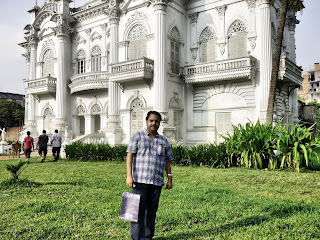
Baliati Zamindarbari is situated about 35 miles northwest of Dhaka and 5 miles east of Manikganj district headquarters. There were two great periods of palace construction in India: the first corresponded to the period of Mughal supremacy from the mid-16th century to the mid-18th century and the second to the British Raj.

In both cases, the provision of an overriding central authority kept rulers in check and accelerated the growth of a provincial elite who gained both power and prestige as local representatives.

During the post-Mughal period, the British weren't the only ones who were changing the construction style. Magnificent palaces were also being built by local feudal chiefs -- Zamindars -- in a style to which was unique in the history of Bengal architecture. The families like Rags of Taras (Pabna), Mitras of Sitlai (Pabna), Chakrabartis of Balihar, Rags of Dubalhati (Naogaon) and Sahas of Baliati (Manikganj) were all Zamindars.

Though Manikganj has lost much of its past glory, its remarkable Zamidnarbaris like the Tosta, Dhankora, Terosri, Pakutia and Baliati and other historic relics, both religious and secular, bear testimony to its rich heritage. Since Manikganj was within Dhaka district, it was more populous and developed than other subdivisions. Moreover, in the early periods of Muslim rule, great Sufis and saints came here for their religious preaching and became famous for their activities. Manik Shah, one of the early Muslim saints, who came to Manikganj, was so famous that it is believed that the district was named after him.

Baliati Zamindarbari is one such remarkable example of the 19th century palaces of Zamindars in Bangladesh. A fascinating set of buildings of their Zamindarbari extended the reputation of the splendour and prosperity of the Saha family throughout undivided Bengal.

The Baliati Zamindarbari originally consisted of five similar but separate blocks. The south facade of grand palace presents an attractive frontage of about 400 feet. Of the extant four blocks of the palace, the two central blocks are two-storied and the other two terminal ones are three-storied. The lofty encircling walls of the imposing Zamindarbari complex is pierced by three superb gateways, identical in their architectural features. Each imposing gateway is spanned by semi-circular arch surmounted by an attractive stucco figure of a lion. The lion gate was a common feature of the feudal palaces in colonial architecture and considered a symbol of pride and strength. The broad facade of the palace with its impressive array of lofty fluted Corinthian columns lining a wide continuous corridor creates a grand consequence.

The vast complex of the Zamindarbari occupies an area of over 20 acres of land that is now beyond verification, while the block situated at the east-end of the building complex has now completely disappeared. The complex comprises over 200 apartments of varying sizes and shapes.

At present, the palace has four inner blocks or 'Mahals'. Each of the blocks situated around an oblong open courtyard behind the front line buildings. On the north there is a big excavated water tank with landing masonary ''ghat'' that leads long succeeding steps towards the water below. On the other side of the tank there are outhouses, servant quarters and stables.

The imposing central block with corridors on both sides is given highest importance. The broad staircase leading to the upper storey is a distinguishing feature of the palace complex around the reception hall dotted with artefacts, odd bits of art and crafts overlooked by a hanging chandelier from top of the ceiling.

In front of the Baliati Zamindarbari there is a temple in a comparatively good state of preservation and an old school and some beautiful fruit trees. Nearly one mile to the south of the palace an artificial tank (dug by the Zamindars) in the middle of which there is a 50 feet high tower set on a square 'Airy Lodge' or 'hawakhana' with four attractive masonry landing 'ghats', one with screenwall that are reserved for women.

The buildings of Zamindarbari are gradually falling apart and in a pitiable condition of neglect. The Department of Archaeology that can still save a large number of these impressive Zamindarbaris from destruction should immediately initiate some efforts.

These Zamindar palaces in outlying areas of Bangladesh that were erected during the British period represented renaissance style derived from the aspirations of the local zamindars to European ideas and consciously cultivated European social habits. This led so significant changes in their palace architecture, featuring classical columns, attractive triangular pediments, semi-circular arches, slender Corinthians columns with acanthus, staircase with flights of steps, hall room in the centre with subsidiary rooms on both sides and elegant stacco decorations. But it is interesting to note that the geographical and social conditions of the region influenced and enriched the architecture by combining European Renaissance elements with some architectural features of Bengal. The individuality of Bengal's architecture comes from such an ultimate resolution of a series of stylistic experiment in a blend of eastern and western architecture that produced an extraordinary heritage of palaces unparalleled anywhere outside Bangladesh. The Baliati Zamindarbari undoubtedly is one of the finest examples of feudal palace architecture developed in the 19th century.

A walk through the History-Old Dhaka:Part-1


A typical narrow road of old Dhaka
The gate of Historical Tara Mosque
Armenian Church at Aremanitola


Image of you in a cloud rolls by
The sky opens up, somewhere in my mind
A vision of you in a pale blue dress
Tears falling down, you took my breath
Memories of you . . .

Rain always hides these tears in my eyes
Thunder laughs and my soul dies
Will I hear your voice
Will I touch your skin
Will the ocean waves let me in

Epitaph read like a warning sign
Lightning strikes, I close my eyes
A vision of you in a torn red dress
Tears in your eyes, your hair a mess
Memories of you . . .

Rain always hides these tears in my eyes
Thunder laughs and my soul dies
Will I hear your voice
Will I touch your skin
Will the ocean waves let me in

The time is near, the time is nigh
To answer the call, to answer the cry
My head still spins, my body aches
Cold wind stings my eyes, my face
Look around, no one there
Will anybody notice, anyone care . . .

Will I hear you laugh
Will I see you cry
Will this world just end and let me die
by Jaimie D. Travis


View Larger Map
A Epitaph
'A FOND WIFE'S TRIBUTE
TO HER DEEPLY MOURNED
AND BEST OF HUSBANDS
CATCHICK AVIETICK THOMAS
DIED 24th SEPTEMBER 1877
AGED 56 YEARS'
Cemetery inside the Armenian Church
The Armenian Church, Dhaka: It is one of the oldest constructions in this city and was built in 1781. The Armenians were rich influential business community. Armenian traders came to the Indian subcontinent in 12th century. After their ample success in trade, Mughal Emperor Akbar permitted them to preach. The Armenian Church in old Dhaka was one of the meeting places for the orthodox Armenian Christians, who observe Christmas on January 7. In the mid-19th century, they numbered no more than about 40 families. Because of their close business ties with the British East India Company, many Armenians became rich 'zamindars' with palatial houses. The church in Armanitola, in the heart of the crowded old city is known an oasis of tranquility. Twice a year the Armenian Archbishop from Australia comes here to hold ceremonies. Mother Teresa during her visit to Dhaka, stayed in this compound. The Church has a chapel with a balcony and the original wooden seat for 100 people. The ground cover nearly a hectare and is paved with 350 old graves stones, some quite ornately carved. Judging by the ages of those buried here, it seems that the local climate suit the Armenians.

The Sadar Ghat

The Sadar Ghat's boy
Jumping is fun..


Rose Garden-A Visit to the Historical Palace


Some Moments of International Mother Tongue Day-2009( Certains moments de la Journée internationale de la langue maternelle-2009)


Flag seller near Central Shahid Minar( Drapeau du vendeur à proximité de Central Shahid Minar)


New genearation has a keen interest on the history of Language Movement 1952( nouveau genearation a un vif intérêt sur l'histoire de la langue Mouvement 1952)


A lady viewing a photo in a exhibition in Bat tola near arts building,D.U(Une dame l'affichage d'une photo dans une exposition de près de Bat tola arts bâtiment, D.U)

A young flag seller selling flags and bands in front of Sharwardi park,Dhaka(Un jeune vendeur de vente drapeau drapeaux et bandes en face de Sharwardi parc, Dhaka)

A young boy named Rubab viewing a photography of Language movement(Un jeune garçon nommé Rubab l'affichage d'une photographie de la langue de circulation)

A couple in a photo gallery of Language Movement 1952( Un couple dans une galerie de photos de la langue Mouvement 1952)


Painting Alpona(art) on face of young boy(Peinture Alpona (art) sur le visage de jeune garçon)

Howai Mithai maker making mithai in a fair in Sharwardi park(Howai Mithai fabricant de mithai dans un parc juste à Sharwardi)

A stunt man performing a acrobat in a over crowed place( A l'exécution d'un cascadeur acrobat dans un endroit bondé de plus)

Alpona on the road

Writing on a wall


An artist painting on the front wall of central shahid minar(Un artiste de peinture sur la façade du centre de séminaire shahid)

Language Movement Photography Gallery at Bat tola,D.U( Langue mouvement Galerie de Photographie à Bat tola, D.U)


Painting Alpona on face-some students earn some pocket money doing it( Peinture sur le visage-Alpona certains étudiants de gagner de l'argent de poche, il fait)


Famous Singer Babu(Ami banglar gan gai...)


Poet Nirmolandu Goon in a photography exhibition

Performing the acrobatic game in a local park


Note:The above photographs were taken on 20th february and 21st february 09.The photographs reflects my deepest respect and feelings.The equipments were Nikon F-80 and Fuji 100 ASA film.No flash used.

History of Bangla Language Movement 1952

The Bengali Language Movement, also known as the Language Movement (Bengali: ভাষা আন্দোলন; Bhasha Andolon), was a political effort in Bangladesh (then known as East Pakistan), advocating the recognition of the Bengali language as an official language of Pakistan. Such recognition would allow Bengali to be taught in schools and used in government affairs.


A big funeral rally on 22.02.1952 after funeral prayers. The police force let loose by government also fired upon this mourning procession.Source:Source: Prof. Rafiqul Islam


When the state of Pakistan was formed in 1947, its two regions, East Pakistan (also called East Bengal) and West Pakistan, were split along cultural, geographical, and linguistic lines. In 1948, the Government of Pakistan ordained Urdu as the sole national language, sparking extensive protests among the Bengali-speaking majority of East Pakistan. Facing rising sectarian tensions and mass discontent with the new law, the government outlawed public meetings and rallies. The students of the University of Dhaka and other political activists defied the law and organised a protest on 21 February 1952. The movement reached its climax when police killed student demonstrators on that day. The deaths provoked widespread civil unrest led by the Awami Muslim League, later renamed the Awami League. After years of conflict, the central government relented and granted official status to the Bengali language in 1956. In 2000, UNESCO declared 21 February International Mother Language Day for the whole world to celebrate[1], in tribute to the Language Movement and the ethno-linguistic rights of people around the world...source wikipedia


21st February 1952: Historic Rally of the students of Dhaka University at Amtola just before Section 144 was violated.Source: Prof. Rafiqul Islam.


21st February 1952: Historic Rally of the students of Dhaka University at Amtola just before Section 144 was violated.
Source: Prof. Rafiqul Islam.